
I have not been doing any serious art supplies shopping for some time now. Most of the tools I use on the day to day basis last me a long time – I use fountain pens for writing and drawing and lead holders for sketching. I can paint many watercolor illustrations for a whole book and only need to refill some of my palette pans from tubes once or so.
I like to keep things this way – there is a certain charm and a warm feeling about working with just a few high-quality tools, getting used to them, and watching them get battle-worn little by little. The low environmental impact of such an approach is also a great upside.
The minus about not using expandable tools is, of course, the lack of a strong excuse to go and pleasurably waste time in an art supplies store more often, especially since the closest one is an hour’s bus and train ride from where we currently live.
Paper is a great exception. Since I lost a lot of good quality watercolor paper to the high Japanese air humidity (it basically ate away the sizing that makes the paper handle watercolors well), I try not to overstock. So, recently, as I only had a few sheets left, I could finally take my son and go on a short trip to Tachikawa’s Sekaido store to stock up on paper and spend some quality time browsing all the tools they have.
One of the things that surprised me very positively was a new line of mechanical pencil leads from Mitsubishi. I often use the Hi-Uni pencils and leads when I need very smooth and stable lines. Until now, if I ran out of mechanical pencil leads, I would need to buy a plastic shell containing forty or so new ones, but now Mitsubishi offers cardboard packages with a whole hundred and sixty leads!


These come in 0.5mm and 0.3mm thicknesses and HB or B hardness. The sleeve has four tear-away openings that hold forty leads each.
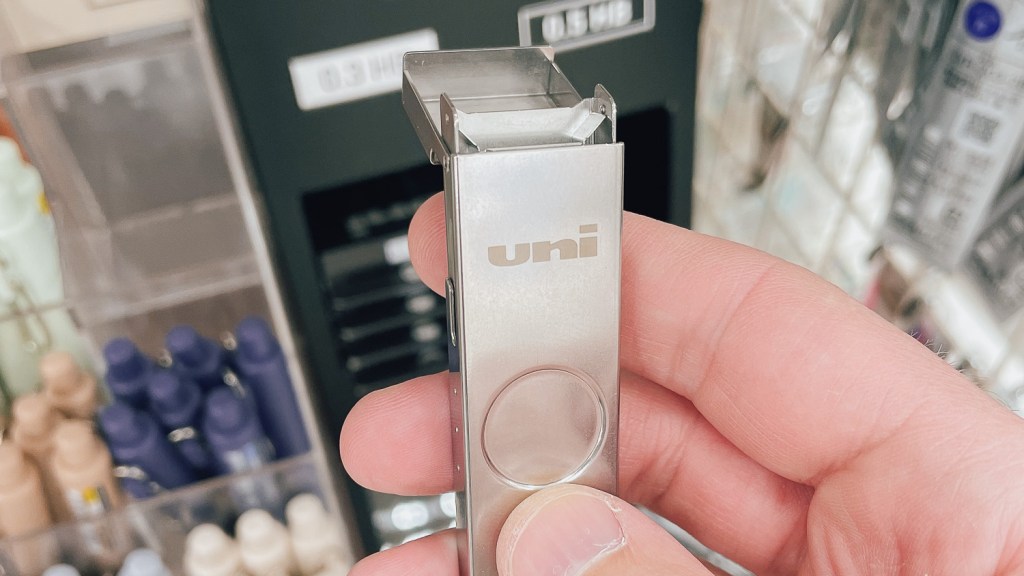
These are maybe not so much aimed at art as at people who write with mechanical pencils – in Japan, the majority of students use 0.3 or 0.5 pencils for writing, and a lot of working people use them too. Now, instead of buying a plastic case every time and throwing the old one away, one can buy a cardboard sleeve and just refill the case. Mitsubishi also introduced plastic and METAL lead cases that have big openings and are easier to refill from the sleeve – just tear open one of the four compartments and shake out forty new leads into your empty case. Close it up and take it in your pencil case to school or work and just keep reusing it.

This is such a great idea – buying one or two mechanical pencils, a lead case, and then just leads packed in cardboard reduces a lot of plastic packaging. I’m especially happy to see such a big brand as Mitsubishi take this step, and I hope others will follow.
The Mitsubishi company even made a small movie about this on their YouTube channel, also talking about the sustainability aspect (in Japanese). A bit cringy, but you can see the system in action too, around the 46s mark. The cardboard sleeve design is plenty smart too, using the wavy insides as compartments!
The only other company doing a similar thing that comes to mind is the Kita-Boshi Pencil with their “adult pencil” series, which features leads packed into cardboard tubes – but these tubes are then wrapped in plastic sleeves, so it’s not that eco-friendly in the end.
I wonder if you have seen any art supplies that went more sustainable packaging lately? If not, we should maybe start nagging our favorite brands to do so!


 Mateusz Urbanowicz
Leave a reply to Marialena Sarris Cancel reply