

Since coming to Japan about thirteen years ago, I have moved houses six times, I think, seven if I count the fact of coming to Japan with only a backpack full of stuff in the first place. In a way, first only to myself, and now together with my wife, Kana, moving houses every two years or so became a bit of a habit, a way to put more exciting things in our lives and keep fresh about our surroundings.
My family in Poland stayed in the same flat since I was born, so my whole life until moving to Japan was spent living in the same apartment, experiencing the same places, and going to the same shops. Unless I went somewhere for holidays, everything stayed the same.
As you would imagine, suddenly moving almost as far as I could to Japan was quite a shock – a completely new environment with so many unknowns. The experience was, at times, quite overwhelming (especially while I did not know the language yet), but to my surprise, most of the time, I felt too interested in and exhilarated by just about everything I saw around me to really care.
Two main feelings surfaced. One was curiosity, of course. Everything was new! Everywhere was worth exploring! The architecture, the way the city felt and looked, the sounds, the smells, strange writing and signs everywhere, even the trees and plants, were new to me. The shortest walk to a neighboring supermarket felt like a neat adventure.
The second feeling was, to my surprise, a weird shade of nostalgia. Sometimes, this gut-wrenching feeling would be so intense that it would literally stop me in my tracks. I would just stare at a building, a strange door, or a street corner and drink in the feeling.
To this day, I wonder why exactly it hit me so hard in Japan and not anywhere else. Nostalgia should be in its original meaning homesickness or longing for the past with happy personal associations. But Japan was not my home, nor did I have exactly any happy feelings associated with it yet. I just came here! I should have been feeling nostalgic and homesick for Poland because of something I saw. But here I was, getting melancholic and tight-chested while walking to a corner 7-Eleven and seeing the evening light hitting some buildings in a pretty way! What gives!?
The only semi-rational explanation for these feelings that I found was the influence of Japanese animation. During the three years of my undergraduate college in Poland, I spent most of my free time binging on any TV anime series I found even remotely interesting – anything from Satoshi Kon’s works or things like “Kaiba” to “Great Teacher Onizuka.” The Japanese cityscapes and surroundings, so faithfully recreated in some of the animations, seeped deep enough into my psyche to make me emotional when experiencing them myself.
I felt nostalgic for a place that I only experienced second-hand. I knew a lot of the sights I met. I even recognized and knew some of the characteristic everyday life sounds, like the automatic door chimes when coming into a shop, the street-crossing chimes, or the way shop attendants greeted coming customers. Living in Japan and going outside, even to take care of a simple chore, was magical – like stepping straight into Narnia or Middle-earth. To be honest, this still gives me goosebumps sometimes.
It’s not only Japan-magic
The twist is that exploring Japan was not the first thing that made me feel like this. Ever since I can remember, even as a kid, I would sometimes get pangs of similar emotion when looking at a particular kind of ruins. Not just every ruins – mind you – I could go to the most fabulous castle remains in Poland and walk around just mildly interested.
But, an old bench in a park lane so forgotten and overgrown that only parts of it remained still visible, for example, would stop me in my tracks. I would take a photo or try to paint something similar later, trying to follow this feeling. This pursuit still plays a huge role in a lot of my art. Even now, as a matter of fact, I very strongly associate this nostalgia-like emotion with things probably worth exploring more artistically the same way other artists might associate the presence of beauty, strength, or movement.
Hyperart Thomasson
There is a park on a hill in Yokohama, for example. It’s called フランス山 – French hill, because at the top of it are ruins of what once was the residence of the French ambassador. The hill and the park are some of my favorite spots in Japan, but what I’m always reminded of is the small staircase in the middle of the ruins – a few steps still standing, just leading to nowhere, ending midair. Magic.
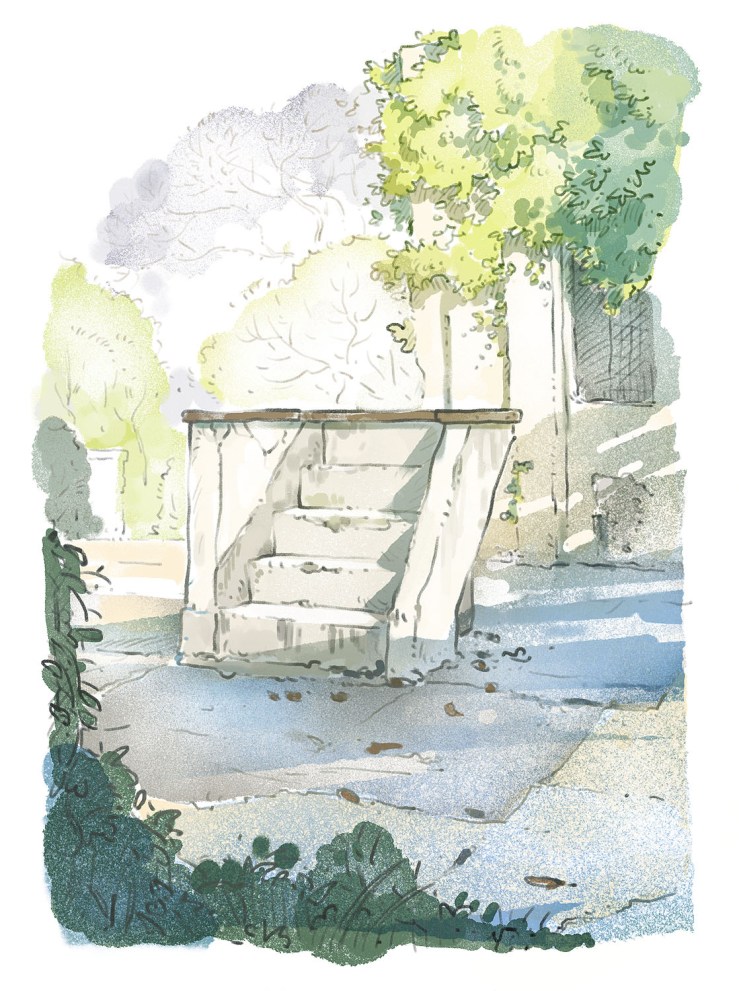
I really wanted to know exactly where this magical nostalgic feeling comes from and what it actually is, so I analyzed it and thought about it more and more. In the end, I even started some research online, which led to something fascinating I learned about just recently.
Apparently, I’m on a well-trodden track because a staircase like this – well preserved but with no purpose anymore – is called a Pure Staircase (無用階段) and is a kind of art-like relic nicknamed Thomasson. It’s a term coined by a Japanese artist, Akasegawa Genpei, that first was used publicly in the “Shashin Jidai” magazine in 1982 and entered the language of people interested in arts and avant-garde.
Akasegawa himself points out that such relics “do not appear to have a creator, which makes them more art than regular art” and even goes as far as calling them Hyperart Thomasson. Apparently, he later published a book of this title on the subject, which I’m very eager to read, but I am currently waiting for the English version to be reprinted.
However, the core idea behind the Thomassons is quite simple and very nicely summarized in just one line by the historian Jordan Sands, who refers to these conceptual art-like structures as marks of “human imprint on the city.”
So this is what I felt when looking at the strange second-floor door leading to nowhere, in a building that looked cut in half, every time I was walking the JR Freight Rinko-Line walk-path in Kobe. I was looking at a Thomasson, a 無用門 (Useless Doorway) – an imprint of humanity on the fabric of reality – like a ghost of a story that I could feel lurking behind it. I could not express or understand this when I was a child, but now I think that what always moved me were things that suggested a story, a human story, to be precise.
Story everywhere
In Poland, I went about my days with my head in the clouds most of the time, not paying any real attention to my surroundings. I only noticed interesting things when I purposefully went to look for them.
Maybe it’s because in Japan, I was a foreigner, my awareness of the surroundings heightened, or maybe my art sense was just a perfect fit for the particular wavelength. Walking around, I could sense the stories lurking everywhere I looked. Every street corner, every staircase or doorway, weird metro passageway or old shop, screamed with something interesting. And the best thing about moving to Kobe was that I actually lived there – I could go out and walk or bicycle for hours on end wherever I wanted and explore to my heart’s content!
Look around!
And so I did – I would take a bicycle a friend gave me and just ride. Go to the Suma beach, see what’s there, try to go all the way to Osaka and back, and spend time in the Kobe port or the Motomachi district just walking around. I hiked around the mountain paths so much that I actually got really lost a few times.
This felt so good as just a way of spending time, but it also greatly impacted my work. Instead of focusing only on trying to draw cool manga-like characters I started to draw and paint the things I saw on my walks. I used them as inspiration for backgrounds for animation and comics and for stand-alone illustrations, too. There were so many unique sights I felt I just had to show through my art!
In my first animation short movie and the comics I did while at the university, all kinds of places from Kobe and the neighborhood played a major role. A dark and spooky tunnel allowing pedestrians to pass from Suma station directly to the beach inspired one scene, a back door of a restaurant, brightly lit in the evening, inspired another cut and a bus stop in the winter snow began a whole scene, and so on.
Before I knew what I was doing, I started collecting the places and scenes in my memory and as photos to then allow them to inspire my next work. I began to explore the stories behind what I saw around me.
Things get stale
But, of course, after a few years in the same place, especially when living somewhere more urban, because of work or school routines, things become stale. The routes I take every day solidify, I get used to my surroundings, and the excitement and interest wane a bit. I could feel the inspiring aspect of being an outsider receding.
I first moved to a new apartment in Kobe, where I stayed for three years, attending the Kobe Design University to continue to study comics and animation. Then, I went to Tokyo to work in an animation studio painting backgrounds for movies. After marrying Kana, we moved four times already – mostly within Tokyo – but we also stayed for two years in Shonan – near the beaches, the famous Enoshima island, and scenic Kamakura.
Each move was a challenge, a financial hit, and a substantial headache to pull off. More and more so, in fact, as the amount of stuff that we have and our needs grew (now we have a small son and a dog to think about, too). However, looking back, I’m happy I had a chance to get to know the atmosphere of so many very different neighborhoods and also to have the experience of living in such a variety of houses.
With each move, the feeling of new surroundings flooding me with inspiration and opportunities to explore was rekindled. Maybe not as strong as when I first came to Japan, but somehow more profound and mature. Now I knew more about Japan, the customs and the history, and I could speak the language. Of course, my exploration of the stories I found became a lot deeper. Instead of looking at a staircase ending in nothingness as a wide-eyed outsider who just experiences nostalgia-like feelings, I could actually ask or research about it. Now, when I saw a weird and unique-looking building, I understood what it was, how and when it was built, and could even deduce and imagine what kind of people were using it. What’s more, because I already spent a third of my life in Japan, based on this experience, I could also start to create my own original stories and plots about what I saw. Ones that actually had some purchase in reality and depth. I was no longer only instinctively reacting to what I saw but creating new things that were only prompted or inspired by what I found. Yes, the intriguing visual side still mattered – I would use a lot of what I found as drawing references, for sure – but now there was a more significant and profound aspect to this experience.
Autumns in Jindaiji
Because I now knew that the surroundings I experienced every day were very important for my art, it became necessary to factor this in when we moved houses. Especially since I understood that it’s not only a matter of looking for simple references for some comic background images – this could be done online or on short location-hunting trips – the surroundings I experienced were one of the main things that influenced and stood at the core of my stories!
There were many other aspects that we cared about, but having an exciting and inspiring neighborhood to explore within walking distance was very high on our list. With a bit of luck, we rented a house in the eastern suburbs of Tokyo, close enough to the Jindaiji temple complex that we are able to just have a stroll there whenever we want. I visited Jindaiji two or three times after I moved to Tokyo because it was just on the list of unique retro locations, and I got very fond of it. It’s not a very huge place, but I love how it’s a kind of hidden gem of retro Japanese atmosphere that, at the same time, is also quite alive. With the temple in the middle, beautiful botanical gardens, and the area filled with traditional soba restaurants housed in wooden buildings, it certainly is not a vestigial remains like a Thomasson. It’s active and very much functioning as a community space.
During the two and a half years living here, our walks and my explorations already yielded a whole book of sketches and paintings of things I found, and I’m sure that the Jindaiji stories seeped through into the ones I created. For example, I suspect that I made a whole short comic about a moon-viewing festival in a city full of Japanese raccoon dogs (tanuki) because there are huge tanuki ceramic figurines in front of many shops around Jindaiji. Yes, in the comic, they eat udon, not soba, but the experience of slurping hot soba noodles with broth on a cold day’s walk is somewhere in there, too. The rest of the comic’s setting is probably inspired by the cityscapes of the center of Tokyo but is based on the atmosphere I absorbed while living there and not any specific places.
I wouldn’t have been able to write this particular story unless I had been living in all the places I did. I would create something different, but not this comic.
As I’m writing, we are still living near Jindaiji, but it has been well over two years, and I can feel the itch to move to a new place getting stronger again. Do we have to move? No. A few things are starting to feel a bit bothersome to us, but these are not dealbreakers. The autumn we spent walking around Jindaiji was as beautifully colorful as last year; the soba is still delicious, and the botanical gardens are a great playfield for our son.
But I already explored all of this quite well. I know the tree stump with an interesting hole in it and the unimpressive castle ruins. I’m familiar with the graveyard from which I can see Mt. Fuji on a fair day and the soba restaurant with a spinning waterwheel. I’m familiar, and I don’t want to be. I want to discover new places and their stories – as many as possible – so I feel it’s time to move again to stay fresh.


 Mateusz Urbanowicz
Leave a comment